

Anecdotes, everyday observations, can have built-in sources of error that can be avoided with experimental studies of good design and correct methodology. On the other hand, the laboratory environment will always be sterile and artificial, and can never replace observations in living life. What you gain in security and precision, you lose in authenticity.
When I told people that Tookie, a dog who lived with us for a few years, had spontaneously chosen to cross the street at a marked crosswalk, it often aroused admiration and people said that it must be a smart dog. This is an example of an anecdote, a single observation that does not tell that Tookie chose completely different places to cross the street at other times.
On the other hand, I could tell about Bera, who kept choosing the same signposted pedestrian crossing. – The catch is that it happens to coincide with a convenient passage to the recycling station that she liked to pass by on her walk.
A pond with carp, a couple of black swans. The swans are picking something from a trough. They dip their beaks into the water among the carp gathered around them. Then a voice: “Feeding the fish”. And then after a while: “They have a good relationship you know”.
On YouTube there are ducks, geese, white and black swans all feeding fish, a behaviour that has led to many reflections. Enviro News had a long explanation about the phenomenon under the heading Black Swans Kindly Feed Their Lunch to Hungry Koi Fish — Tell Us Why! and a follow-up question asked “Is the swan an extremely kind-hearted and caring bird? Or are they just so stupid that they give away their food to some who can't give them anything in return?”
In Enviro News, two possible explanations were given. One is that the food in the troughs is dry and that a soaked food passes more easily through the swan's long neck. The second is that the fishes' open mouths resemble the open beaks of swans. The open beaks were supposed to trigger the swans' feeding instinct. In that case, it would be an example of Nikolaas Tinbergen's concept ‘hyperstimuli’—an adequate behaviour as a reaction to a wrong stimuli. But swans do not feed their young. They just show them what to eat.
If you study those clips carefully, you will see that the swans are actually trying to stick their beaks down where it is relatively fish-free at the moment. It can be a bit tricky to see it, because the fish move quickly.
After the swans hatch, the parents take them out into the water and show them what they can eat. In the first clip, you can see how the little swans soon after hatching leave the nest to eat on their own. In the second clip, the typical behaviour of dipping the beak in water is seen, even if the food is soft like boiled corn.
So the story is about carps who try to get the food that the swans have in their beaks when they dip it. What the real motive is, whether it's to wet the food, wash it down or a way to drink, we don't have to worry about now that the focus is on sorting out wrong perceptions.
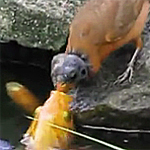
In conjunction with clips about birds feeding fish, National Geographic appeared with something of a challenge. According to the owner of the pond, a red cardinal (Cardinalis cardinalis) comes every day and feeds the goldfish. This is repeated a number of times each day. National Geographic has published this under the heading Bird Filmed Feeding Goldfish—Here's Why.
The first question is whether there is any exchange at all and, if so, with what. In the first two pictures, it is not possible to see if the bird is leaving anything behind. In the third picture, there is a worm-shaped object between the beak and the fish mouth:
It could possibly be a bird that has lost its own chicks. But there are several examples of birds feeding another animals (but then they are domesticated pets and live under the same roof).
Here we have two situations that look the same, but are two different stories: The swans probably dip the food (often pellets) to moisten it. The cardinal may indeed feed the fish, although it must be rechecked if it actually does so.
It may be hard to resist the joy when animals display qualities that we seek. The sceptic objects, the heart agrees. Scenes like these are perhaps best left open. The sceptic must have some rights too.
A dog chases a stick thrown into the crest of a small rapid. The dog jumps in, gets hold of the stick, is pulled along in the rapids and would probably continue all the way down to the harness, unless another dog grabbed the stick and pulled the dog onto solid ground. The dog is saved from further rafting and the hero gets the stick for himself.
What was the hero thinking? The intention is of course to grab the stick, but the motive? Maybe it really was a hero who stepped in and saved a comrade, or was it just a selfish act to get the stick? The observer hears two voices, the benevolence of feeling, the thought's critical questioning. When you can't reach a decision the most reasonable position should be &dquo;I don't know”.
The motive for an action is mostly difficult, if not impossible, to determine. The intention, on the other hand, is often quite easy to see. You can often determine what the action is aimed at, but what triggers the action will mostly be an enigma.
Take, for example, the cat that rushes out and chases away the dog (Chapter Story, Intention, Motive). It is obvious that the intention is to drive the dog away. But why does the cat drive the dog away? To save the boy? To protect a territory? Because of previous settlements? Have kitties kids nearby?
Despite all the uncertainty, in some cases you can guess the motive with a reasonable margin of error, but a prerequisite is that you know the animal well. As a specie, as a race, as an individual.
There are many clips of hippos said to save zebras, wildebeests and antelopes from crocodiles. Hippos are vegetarians, but known to be extremely short-tempered and with a very firm opinion about the rules in the area where they dwell. Above all, they want peace and quiet. Here follows an interesting example that highlights what about most ‘rescue actions’ really is.
Mala Mala game reserve, South Africa: A hippopotamus stands at the end of an elongated, narrow mud pit. Two rather steep slopes with dry soil and sparse vegetation surround the pit. Two wild dogs stand on the bank along the far side of the pit. They are hunting an antelope. A third and a fourth wild dog join and finally they are five.
Then the hippo intervenes by running down the mud pit and diagonally up towards the bank with the dogs and drives them away. The wild dogs let go of their prey and back away, whereupon the antelope takes a leap into the mud where it is stuck. The hippo steps down into the pit, looks at the antelope, and then lies down with the antelope to rest in the mud pit. The hippopotamus has now placed itself between the bank with the dogs and the antelope in the mud.
A temporary calm prevails. On the beach, the dogs are waiting. Unfortunately, there is a cut in the film here. In the next scene, one of the dogs has made it to the near bank and is now in a position so that it can reach the antelope. How much time has passed since the previous scene we do not know. What happened during the undocumented time may possibly have an impact on the outcome. The dog's grip on the antelope is no stronger than the antelope can shake off. The calm is gone.
The hippo wakes up and bites the antelope's head several times, then walks a couple of meters to the side and sits down with its right side facing the antelope and the wild dogs. The hippo can now see what happens between the antelope and the wild dogs. The dogs can't really reach the antelope.
Now the hippo takes a good hold of the front part of the antelope's back and makes a few throws back and forth and releases the antelope so that it ends up lying right on the edge of the pit. Could very well have had the spine broken. The dogs can now take it and four dogs drag the body up the slope and more dogs join. They drag the antelope away. The peace in the mud pit is restored.
With this in mind, you might look at the Youtube ‘hippo rescues’ a little differently. More than rescuing an attacked animal, it is mostly about removing disturbing elements, both attackers and victims.
Here is a typical example. It is worth noting that only a couple of words are needed to transform the description of the scene. It is not the same to say “Hippo attacks crocodile to save ... ” as “Hippo attacks crocodile and saves ...”. One must be careful with intentions with which dramatized nature films often are so generous.
An unanswered question is whether in any case it occurs that an animal rescues, helps or shares something with an individual of another species. I intend to return to that question later. I will stay for a while on the problem with the titles of the clips, which can easily lead astray and skew the interpretation.
The title of a clip often works like newspaper headlines: it is more about capturing interest than providing a true description. An example is the following clip which, after previously being launched with the heading Dog and Turtle Play With Ball now has the more appropriate title Aggressive turtle plays ball with a dog.
Even if the new title is better, it could be more correct to call it Little turtle wants the dog's ball for himself. In any case, you have to be careful with the headlines, they are often created haphazardly.
The combination turtle and ball comes in many varieties. Search for “turtle play ball” will result in many ball-playing turtles. Here are a couple of examples. Notice the difference in technique. The first is content to move the ball in front of him, the second pulls his head in and gives the ball a ‘kick’. Probably a personal disposition, but it could also depend on how they are used to handling balls. Or what role models they have had.
Here, finally, an example where you can really talk about two animals playing ball with each other. A dachshund, a turtle and a ball.
When you see the determination and focus of the turtles with a game that has absolutely nothing to do with survival, one wonders how it was that it took until the end of the twentieth century for it to become legitimate to talk about animals being able to have consciousness. That is, in scientific contexts. Those who interacted with animals and took them seriously have probably never harboured any doubts.
Speaking of turtles, they can be really empathetic and help an abandoned fellow turtle.
The problem how easy it is to deceive deceive the eye with relatively simple means must also be tackled. With help of AI and advanced video editing tools, astonishing results can be obtained and the need for extra checks and criticism of the sources will grow to the corresponding degree.
Bear fighting and kangaroo boxing, maybe not so hard to determine what is fake and what is real, but there are other manipulations of reality we have to watch out for. They may appear in contexts that make them really dangerous. When they involve people, they are possibly even more difficult to uncover than when it comes to animals, and at the same time more dangerous. Animal clippings do not so often enter politics.
Be prepared that there exist people that don't hesitate to put an animal in a dangerous position just to be able to document a hero rescue. There are dark corners everywhere.
There will always be clips that document difficult-to-judge behaviour. Situations that can be interpreted as considerate and caring may in fact be about a frightened animal. One might ask how much of a SPA feeling it is for a rabbit to lie stretched out on its back in a sink with water splashing on its belly. Maybe it's ok if it's used to it and safe, maybe it's scared out of its wits and playing dead? Why place a hedgehog on its back in a sink with bubble bath?
Animals are personalities, so of course there can be individuals who enjoy something that for another is pure horror. In any case, the basic rule for an ouside observer must be to look with scepticism at situations where an animal does not signal that it is a partner in the situation. Likewise when it seems that man puts his own interests and preferences before the animal's. Why would a hedgehog bubble bath?
Many clips show animals in vulnerable situations. Dogs run into the wall, cats pulsate in meter-deep snow, people laugh, the music is noisy, one situation succeeds the other, dogs, cats, rabbits, guinea pigs, they fall, get stuck, roll, fall, tremble, miss – in general, animals that fail or behave stereotypically and become a laughing stock. It's not the animals that are doing away, such clips are examples of people showing lack of respect.
It is not only the animals that are violated, human dignity is also disgraced. Despite the hesitation, I will show an example of disrespect and mutual humiliation.
It is not always easy to determine whether a behaviour is spontaneous or trained. When it comes to YouTube clips, you can at least try to watch out for attempts to make a behaviour appear spontaneous when it is not. Be critical.
Many YouTube clips are about animals living in families with humans. This means that the dangers of life in the wild have been replaced with security. No enemies and no doubts for today's food. When you fall asleep, you can sleep peacefully. That indeed changes behaviour.
However, that is not the life of the vast majority of the earth's mammals. Life in the animal industries and in the laboratories is a life in fear and despair, a stolen life not worth living. However, such is the life of the vast majority of the earth's mammals.
Sometimes you end up on weird clips, that defies one's ambitions to interpret and understand. Clips that lack logical handles and have no sensible approach. A dog carrying a cat like a sack on a pack donkey. Why? There should be an explanation, but where? The cat seems to be able to walk, stand it does anyway and actually also takes a couple of steps. Then the dog is there again and carries the cat all the way to the door. The explanation may lie in the voice that keeps repeating the same words, something like ”damoi nisí”. Something trained? Strange anyway. But not everything doesn't need to be explained.